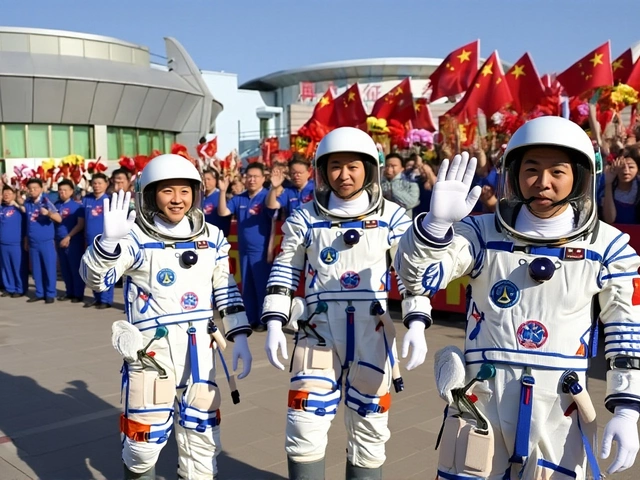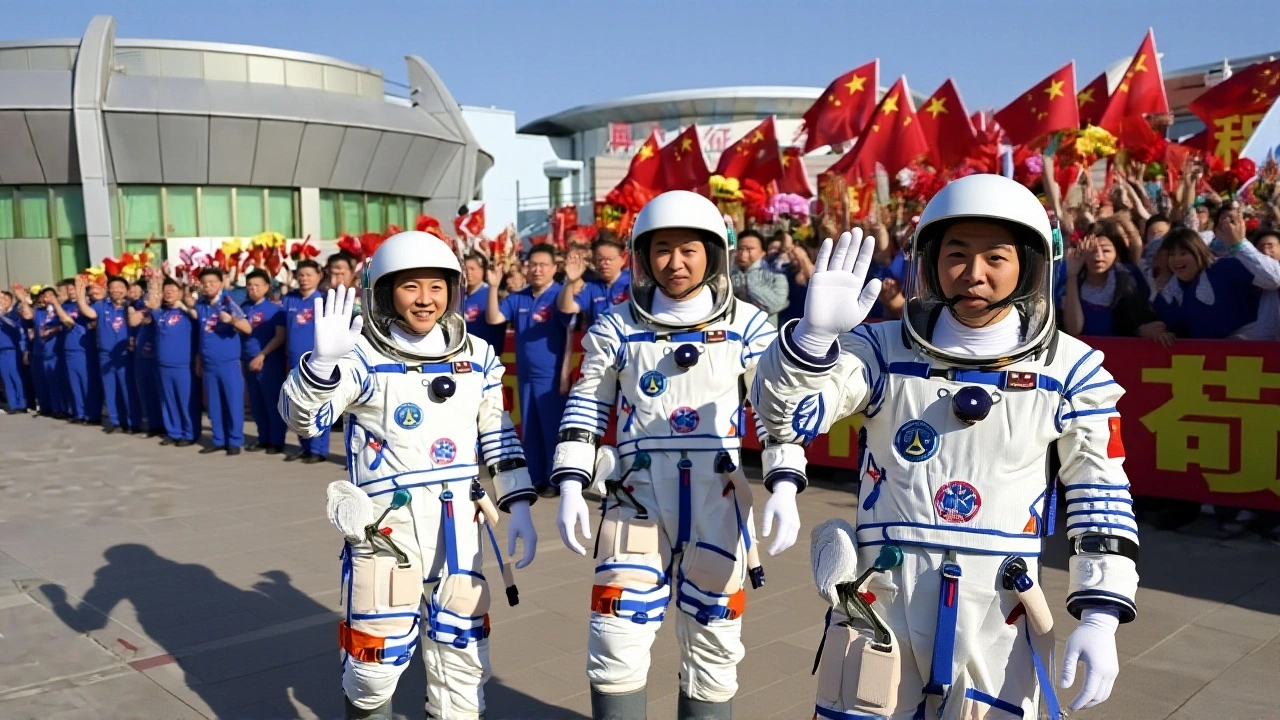
At 11:11 p.m. EST on November 25, 2025, a China Manned Space Agency launched the uncrewed Shenzhou 22 mission Jiuquan Satellite Launch Center aboard a Long March 2F/G rocket from the remote Gobi Desert in northwest China — not for routine crew rotation, but for an emergency rescue no space program had ever attempted before. Four and a half hours later, the spacecraft docked with the Tiangong space station, ending a 14-day nightmare for three Chinese astronauts who had been stranded without a return vehicle since November 11, 2025.
How a Minor Crack Turned Into a Life-or-Death Crisis
It started with a tiny flaw. On November 5, 2025, just hours before the Shenzhou 20 mission was set to bring its crew home, engineers discovered minor cracks in one of the spacecraft’s windows — likely caused by a micrometeoroid or orbital debris impact. The China Manned Space Agency immediately grounded the vehicle. No one had ever flown a Shenzhou spacecraft with window damage. The risk? Catastrophic depressurization during reentry. The crew of Shenzhou 20, who had arrived on October 31, 2025, were told they’d have to stay aboard Tiangong — indefinitely.
Here’s the twist: Shenzhou 21 had just arrived on Halloween night, October 31, 2025, with its own crew of three. With two crews aboard and only two return vehicles — Shenzhou 20 (grounded) and Shenzhou 21 (their own ride) — the agency made a gutsy call. On November 11, 2025, the Shenzhou 20 crew used the Shenzhou 21 spacecraft to return to Earth, leaving their own vehicle behind. That meant the Shenzhou 21 astronauts were now stuck — with no lifeboat. Their original ride was gone. The backup was broken. And the next scheduled return vehicle, Shenzhou 22, wasn’t due until April 2026.
An Unprecedented Decision: Launching a Rescue Ship Without Crew
That’s when the China Manned Space Agency did something never done in human spaceflight history: they launched an uncrewed Shenzhou spacecraft as a rescue vehicle. Shenzhou 22, originally meant to carry three astronauts to Tiangong in spring 2026, was stripped of its crew seats and packed with extra oxygen, food, water, and spare parts. It launched on November 25 — just 14 days after the Shenzhou 21 crew lost their ride home.
The mission succeeded. Docking occurred flawlessly. The astronauts aboard Tiangong — still unnamed, still anonymous — now had a guaranteed return vehicle. They’ll stay until May 2026, completing their full six-month mission. The damaged Shenzhou 20 spacecraft? Still docked. Officials confirmed it will be deorbited and recovered for forensic analysis. "It didn’t meet safety standards," said CCTV, China’s state broadcaster. "We will bring it down and assess it."
Why This Changes Everything — Even for Rivals
This wasn’t just a technical win. It was a geopolitical one. Tiangong, meaning "Heavenly Palace," was built because the U.S. barred China from the International Space Station (ISS) in 2011 over national security concerns. Since 2021, China has operated Tiangong entirely on its own — no international partners, no shared protocols, no backup systems. The entire system relies on one rocket, one spacecraft, one launch site. And now, it’s proven it can improvise under pressure.
But that’s also the problem. The world watched as three astronauts floated in orbit, waiting for a rescue that only their own country could provide. There was no international protocol. No European or American vehicle could have reached them. No Russian Soyuz could have docked with Tiangong. The incident has sparked urgent talks in Geneva, Washington, and Tokyo about creating a global "space rescue service" — a kind of orbital Coast Guard capable of aiding any crew, regardless of nationality.
"We’ve always assumed national programs could handle their own emergencies," said Dr. Elena Vasquez, a space policy analyst at the Center for Strategic and International Studies. "But this shows that if you’re isolated, you’re vulnerable. What if it had been a medical emergency? Or a system failure during reentry? There’s no safety net."
What Comes Next: Shenzhou 23, Debris, and the New Normal
The next major milestone is Shenzhou 23, scheduled for April 2026. It will deliver the next crew to Tiangong — and take over as the new return vehicle for the Shenzhou 21 astronauts. Meanwhile, the damaged Shenzhou 20 spacecraft will be undocked and intentionally deorbited, burning up over the South Pacific in late 2026. Engineers will study the window cracks to determine whether this was a one-off event or a systemic flaw in the spacecraft’s thermal shielding.
China’s space program, controlled by the military and headquartered in Beijing, has shown remarkable speed and precision. But this event exposed a quiet truth: isolation breeds risk. Even the most advanced systems can’t account for every variable in space. The fact that they pulled off this rescue — with no prior precedent — speaks volumes. But it also raises a question: should space be this dangerous?
Behind the Scenes: The Rocket, the Center, and the People
The Long March 2F/G is China’s only human-rated rocket, built by the China Academy of Launch Vehicle Technology, a division of the state-owned China Aerospace Science and Technology Corporation. It’s been flying since 1999, with a 100% success rate for crewed missions — until now, it’s never had to fly without a crew. The Jiuquan Satellite Launch Center, established in 1958, is China’s oldest and most critical launch site, nestled in the Gobi Desert. Its isolation helps with security — but also means there’s no nearby infrastructure for rapid response if something goes wrong.
And while the astronauts’ names remain classified — as is standard in China’s military-run program — their survival is a quiet triumph. They didn’t just endure 14 days without a ride home. They worked, exercised, monitored systems, and waited — knowing that if the next launch failed, they might never see Earth again.
Frequently Asked Questions
Why was Shenzhou 22 launched uncrewed?
Shenzhou 22 was originally scheduled for a crewed mission in April 2026, but with three astronauts stranded aboard Tiangong and no safe return vehicle available, China’s space agency repurposed it as an uncrewed rescue craft. This allowed them to deliver a functional return vehicle without risking additional lives during the emergency. The spacecraft carried extra life support supplies to compensate for the extended stay of the Shenzhou 20 crew.
How did the Shenzhou 20 spacecraft get damaged?
Engineers detected minor cracks in one of the spacecraft’s windows shortly before its scheduled November 5, 2025, return. The damage is suspected to be from a micrometeoroid or small piece of orbital debris — a known risk in low Earth orbit. While the cracks were small, they were deemed a catastrophic risk during reentry, where pressure differentials could cause explosive decompression. No prior Shenzhou mission had ever flown with window damage.
Is this the first time a space rescue mission has been attempted?
Yes. While the International Space Station has had contingency plans for crew emergencies — including the ability to use a docked Soyuz as a lifeboat — no nation has ever launched an uncrewed spacecraft specifically to rescue stranded astronauts. This marks the first time a space agency has executed a purely rescue-focused mission, making it a historic milestone in human spaceflight.
What happens to the damaged Shenzhou 20 spacecraft?
The damaged Shenzhou 20 spacecraft remains docked to Tiangong as of late November 2025. It will be undocked and intentionally deorbited in late 2026, with debris expected to burn up over the South Pacific. Engineers will recover any surviving fragments for forensic analysis to determine the exact cause of the window damage and whether it points to a design flaw in the Shenzhou fleet.
Why can’t other countries help in future emergencies?
Tiangong’s docking systems are incompatible with U.S., European, or Russian spacecraft. Even if a Soyuz or Crew Dragon were launched, they couldn’t physically connect to China’s station. There’s no international standard for cross-compatible rescue vehicles. This incident has highlighted a dangerous gap: space is global, but rescue protocols are national. Experts now urge the creation of a global emergency response framework.
Will this change how future space missions are planned?
Absolutely. NASA and ESA are already reviewing their own contingency plans, especially for missions beyond low Earth orbit. China’s success may push other nations to develop their own rapid-response uncrewed vehicles. But more importantly, it’s forcing a global conversation about shared safety standards — not just for technology, but for policy. The next crewed mission to any space station may need a backup rescue plan that doesn’t rely on national pride.